
Where to report
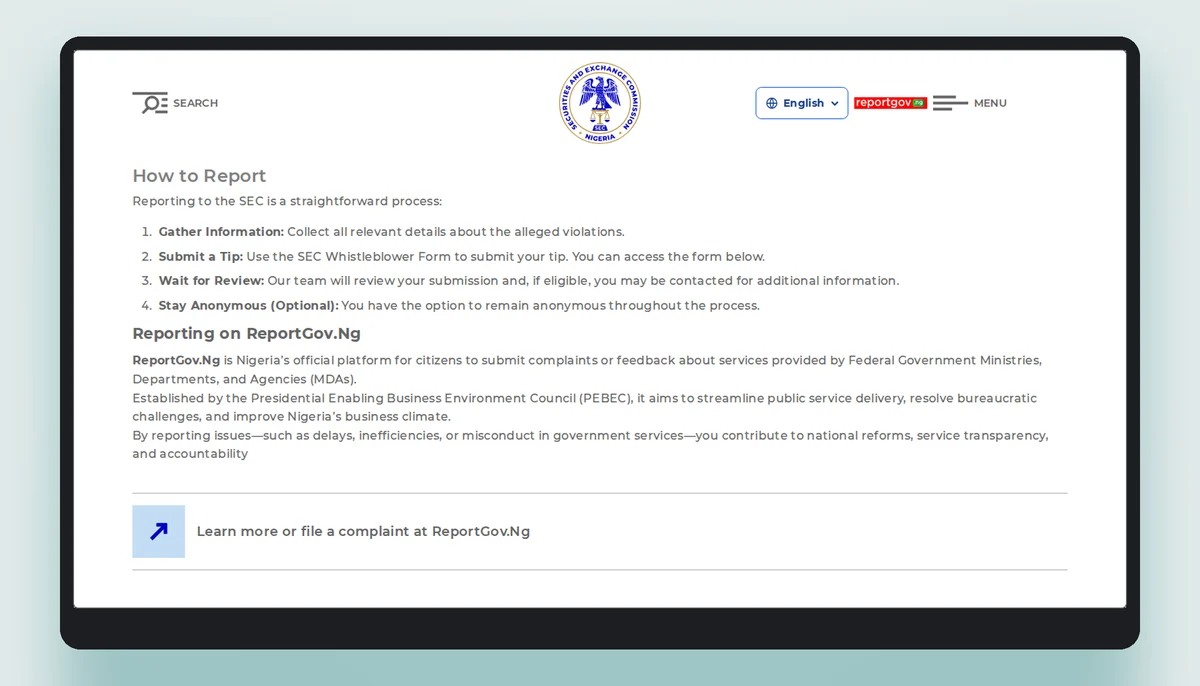
If you have placed money with a scheme that has stopped paying, or if you suspect an investment scheme is not registered, there are several bodies you can report to. Each body has a different role. This page explains who receives what and what to bring.
The SEC for investment schemes
The Securities and Exchange Commission receives complaints about investment schemes. If an entity is offering investments and is not registered, you can report it to the SEC. The SEC may investigate and may add the entity to its list of known investment schemes.
To report, gather your documents: receipts of payments, chat exports, and any agreement you signed. Write to the SEC with the details. The SEC's website has a complaint form. The SEC does not promise a refund; it is a regulator, not a recovery agent.
The EFCC for fraud
The Economic and Financial Crimes Commission investigates financial crimes, including investment fraud. If you believe you have been defrauded, you can report to the EFCC. The EFCC may investigate and prosecute.
Bring the same documents: receipts, bank statements, chat exports, and any written agreement. The EFCC does not promise to recover your money. It is a law enforcement agency.
The police cybercrime unit
The Nigeria Police Force has a cybercrime unit that handles online fraud. If the scheme operated online, you can report to the police. The police may investigate and refer the case to the EFCC or the courts.
Bring your documents and be prepared to give a statement. The police do not promise a refund. They are a law enforcement agency.
The FCCPC for consumer complaints
The Federal Competition and Consumer Protection Commission receives complaints about consumer rights. If the scheme sold you a product or service that was not delivered, you can complain to the FCCPC. The FCCPC may mediate or take enforcement action.
Bring your receipts and any correspondence. The FCCPC does not license investment schemes, but it can act on unfair practices. It does not promise a refund.
Your bank for a transfer made
If you made a transfer to the scheme, you can contact your bank. The bank may be able to freeze the receiving account or reverse the transfer if it was recent. The bank will ask for your transaction details and a police report or other evidence.
The bank does not promise to recover the money. It will act according to its own policies and the law. Report to the bank as soon as possible.
What to bring
Bring everything that shows what happened: receipts of payments, bank statements, chat exports, emails, and any written agreement. Write down the names of the people you dealt with, the dates, and the amounts. Keep copies for yourself.
No body can promise a refund. The agencies can investigate and may take action, but recovery is not guaranteed. The reader should report to the relevant body and then wait for the process.
A report to one agency does not close the others
Each regulator works inside its own lane. The Securities and Exchange Commission responds to unregistered investment schemes and capital-market operators. The Economic and Financial Crimes Commission takes up criminal fraud when money has been collected under false pretences. The Federal Competition and Consumer Protection Commission handles consumer complaints about goods, services, and unfair trade practices.
A single report to the SEC will not automatically reach the EFCC or the FCCPC. The agencies do not share every file, and each one decides whether a matter falls under its own law. A reader who reports to only one body may wait while the others never open a file.
The practical step is to decide what kind of harm has occurred, then report to the body whose law covers that harm. If the same conduct breaks more than one law, a written report can go to each agency. Keeping a copy of each acknowledgement helps a complainant follow up.
Your bank can freeze a transfer while it is still pending
A bank acts on instructions from its customer. When a transfer has just left an account and the beneficiary has not yet received value, the sending bank can place a hold or request a recall through the interbank settlement system. This works best within the first hours, before the money is withdrawn or moved again.
The bank will ask for a written complaint, the transaction reference, and a short statement of what was promised. No bank can promise to recover money that has already been withdrawn as cash or moved through several accounts. The speed of the report determines what the bank can attempt.
If the receiving bank says the funds have cleared, the customer should still ask for a formal complaint number. That number becomes part of the paper trail for the EFCC or the police. A bank report alone is not a substitute for a criminal complaint.
A CAC search is not a report
The Corporate Affairs Commission keeps the register of companies and business names. A search there tells you whether an entity exists as a legal person and who its directors are. It does not tell you whether the entity may collect money from the public, and it does not open an investigation.
Some readers search the CAC portal, see a company name, and assume the matter is settled. That is a mistake. A CAC certificate is a requirement for many businesses, but it is not a licence to take deposits or run an investment scheme. The SEC and the CBN issue those licences.
If a company is not found on the CAC register, that fact is worth reporting to the CAC's compliance unit. But the CAC will not chase the promoters or recover money. Its power is limited to striking off the name or prosecuting for failure to register.
When the FCCPC can act on a direct-selling complaint
The Federal Competition and Consumer Protection Commission regulates trade practices, including multi-level marketing and direct selling. They can act when a business misleads consumers about the nature of the product, the earnings opportunity, or the refund policy. A joining fee that buys nothing but the right to recruit is a trade practice issue.
The FCCPC does not license investment schemes. If a platform combines a product with a promise of returns from recruiting, the FCCPC may investigate the consumer protection angle while the SEC looks at the investment angle. A complaint to the FCCPC should focus on the misleading conduct, not on the loss of money.
The FCCPC can issue cease-and-desist orders, impose fines, and shut down a business. But they cannot order a refund to every participant. Their orders are public and can be used as evidence in a private lawsuit or a criminal case.
No body can promise you will get your money back
Every agency in Nigeria that receives a complaint has the power to investigate, sanction, or prosecute. None of them has the power to guarantee a refund. The money may have been spent, moved offshore, or divided among many accounts. Recovery is a separate process that often requires a court order.
A complainant who expects a regulator to return funds will be disappointed. The SEC can seal an office and publish a warning. The EFCC can freeze accounts and charge suspects. The FCCPC can revoke a registration. But the actual return of money depends on what assets are found and how the court distributes them.
The most realistic path is to report early, keep all evidence, and follow up with the agency that has jurisdiction. A report is a request for enforcement, not a claim on a fund. The sooner the report is made, the better the chance that assets are still within reach.
The EFCC takes reports only after a crime is alleged
A report to the Economic and Financial Crimes Commission is not the first step for a slow withdrawal or a promise that was not kept. The commission acts on complaints that describe how money was taken under false pretences, with dates, amounts and the account that received the transfer. Without those details the file cannot move from an inquiry to an investigation. The same desk that receives a petition about a failed investment also receives petitions about contract fraud and payroll fraud, so the intake officer will look for the elements of an offence before anything else.
The practical consequence is that a person who reports too early may be told to return to the platform and ask for the money, or to bring the matter to a civil court. The EFCC does not recover funds as a first action; it builds a case. That case needs a complainant who can state that they were promised a return and the return did not come, or that the promoter disappeared after collecting money. A report that says only that a scheme is on the SEC list will not carry the same weight as a report that attaches the acknowledgement from the bank.
The order of operations matters. First gather the payment evidence and the promoter's messages. Then decide which agency fits the complaint: the SEC for an unregistered capital-market operator, the FCCPC for a consumer transaction, the police for cyber-enabled fraud. If the facts show a crime, the EFCC is the place. But the commission does not promise recovery, and a petition does not stop a scheme from taking in new money while the file is being reviewed.
The FCCPC handles unfair practices, not unlicensed investing
A complaint to the Federal Competition and Consumer Protection Commission fits when the scheme sold a product or service and the terms were unfair. That includes hidden fees, refusal to honour a withdrawal request, or misleading advertising about what the buyer would receive. The FCCPC does not licence investment schemes, and it does not maintain a list of known Ponzi structures. Its focus is the transaction between a consumer and a business, not the registration status of the business with the SEC.
A practical distinction readers get wrong is the difference between a product and an investment. If the platform sold a course, a gadget or a subscription, the FCCPC can look at the sales practice. If the platform sold an 'investment package' with a promised return, the SEC is the body to ask about registration. The same entity can appear in both places: a business can be registered at the CAC, warned by the SEC, and still have consumer complaints at the FCCPC about how it handled refunds.
The order of operations for a consumer complaint is to first write to the business and keep the response, then file with the FCCPC if the matter is not resolved. The commission can mediate, issue a cease-and-desist, or impose a penalty, but it cannot return money that was lost to a Ponzi. That remains the job of the courts. A reader who sends an investment complaint to the FCCPC will be redirected to the SEC, which delays the matter by a few weeks.
Your bank can stop a transfer only before it settles
A bank's fraud desk can place a hold on a transfer that is still pending, but once the money has been credited to the receiving account the bank cannot simply pull it back. The window for a recall is measured in minutes for an instant transfer, and a little longer for a scheduled transfer. After settlement, the bank can only raise a dispute with the receiving bank, and that process depends on the receiving account still having funds. In a typical Ponzi scheme the receiving account is drained quickly, so the dispute often fails.
The practical consequence is that a person who realises the mistake the same day should call the bank before writing to any regulator. The bank will ask for the transaction reference, the amount and the account number. If the transfer was made through a third-party payment processor, the bank may not be able to see the final beneficiary, and the user will have to contact the processor. A report to the bank is not a report to the police; it is a request to halt a payment that has not yet completed.
What no body can promise is the return of money that has already moved. The bank will say that it can only act on an instruction from a court or a regulator, and that takes time. The SEC can publish a notice, but the notice does not freeze a bank account. The EFCC can freeze an account, but only after a court order. The reader who understands this will not wait for a regulator to act before asking the bank to stop a pending transfer.
Who receives what
Read next
Asked at the point of paying in
Which body should I report to first?
It depends on the nature of the problem. If it is an investment scheme, report to the SEC. If it is fraud, report to the EFCC and the police. You can report to more than one body.
What documents do I need?
Receipts of payments, bank statements, chat exports, emails, and any written agreement. Keep copies for yourself.
Can the SEC get my money back?
The SEC is a regulator, not a recovery agent. It can investigate and may take action, but it does not promise a refund. No body can promise a refund.
What does the EFCC do?
The EFCC investigates financial crimes, including investment fraud. It may prosecute offenders. It does not promise to recover your money.
Should I report to my bank?
Yes. Your bank may be able to freeze the receiving account or reverse the transfer if it was recent. Report as soon as possible.
Open a CFD account with an international broker
If you are looking for a broker to trade contracts for difference, this site links to FxPro. Read the risk warnings and the client agreement before opening an account.