
How a Ponzi and a pyramid work
A Ponzi scheme and a pyramid share one structural feature: they pay early members from money put in by later members. There is no underlying business earning profit. The scheme appears to work while new money arrives, and it slows when new money slows. This page explains the mechanics in words, without figures.
The core mechanism
In a Ponzi scheme, the operator collects money from investors and promises a return, often a high regular return. The operator uses money from new investors to pay the promised return to earlier investors. Little or no money is invested in any real activity. The scheme depends on a steady flow of new money.
When new money slows, the operator cannot pay the promised returns. The scheme then collapses, or the operator disappears. The early investors may have received money, but that money came from later investors, not from profit.
Why high regular returns are the tell
A promise of high regular returns with no stated source of profit is the structural tell. Legitimate investments do not promise a fixed high return regardless of conditions. A business that could earn such returns would not need to borrow from the public at those rates.
The question to ask is: where does the profit come from? If the answer is vague, or if the answer is that other people will join, the structure is likely a Ponzi or a pyramid. The return is not from economic activity; it is from new deposits.
The pyramid's recruitment engine
A pyramid scheme is a specific form: members are paid for enrolling new members, not for selling a product. The product, if any, is a cover. The real product is recruitment. Each level of members recruits the next level, and the money flows upward.
The scheme must grow geometrically to sustain itself. It cannot. Eventually there are not enough new members. The people at the bottom lose what they put in. The people at the top may have profited, but from the losses of those below.
What questions expose the structure
Ask the promoter: What is the source of the profit? What exactly does the business do? Who are the customers? How much of the money comes from sales and how much from new members? If the answers are vague, or if the emphasis is on recruiting, the structure is likely a pyramid.
Also ask: What happens if no new members join? A legitimate business can continue from its own sales. A pyramid cannot. The answer to that question often reveals the structure.
Why withdrawals slow when new money slows
In a Ponzi or pyramid, the money to pay withdrawals comes from new deposits. When new deposits slow, the operator has less money to pay withdrawals. The operator may delay, impose new conditions, or stop paying altogether.
The slowdown is not a temporary problem; it is the structure failing. The scheme was never earning enough to pay the promised returns. It was only redistributing new money. When the flow stops, the redistribution stops.
What the regulator says
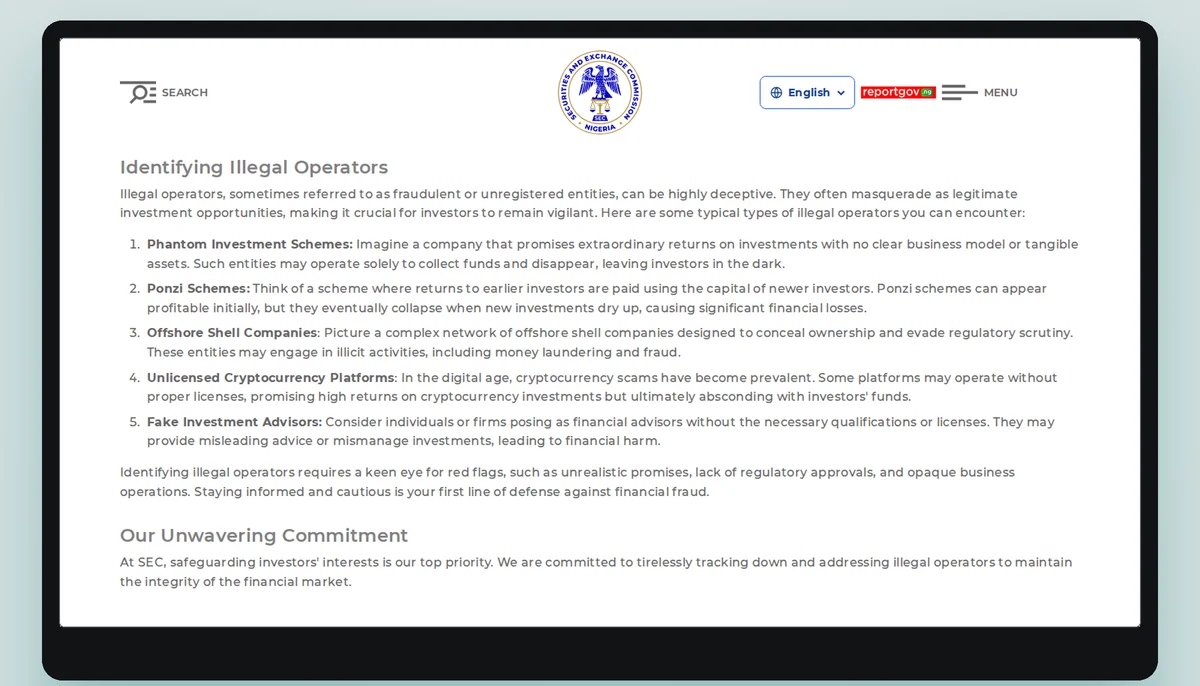
The Securities and Exchange Commission of Nigeria warns against schemes that promise high returns with little risk. The Commission says that entities offering investments must be registered with it. A scheme that is not registered is not authorised to take investments.
The SEC's list of known investment schemes names entities the Commission says are not registered. The list is a warning. The reader should check the list and read the SEC's notices before placing money with any scheme.
The payout promise hides the only source of money
A promoter who promises a fixed return every month has to find that return somewhere. If the business does not sell a product or service that generates profit, the only available source is the money coming in from new participants. The promised payout is not a share of profit; it is a slice of someone else's deposit.
The books of such a scheme show a simple flow. Each naira paid out to an early participant was paid in by a later one. The operator may call it trading or investing, but no external revenue stream exists. The scheme depends entirely on a growing number of contributors.
When the inflow of new deposits slows, the promised payouts become impossible to sustain. The operator must either reduce the payouts, delay them, or stop them altogether. This is not a market downturn; it is the arithmetic of the model.
Recruitment turns the participant into the product
In a pyramid, joining is not enough. The existing structure needs the new person to bring in more people, and those people to bring in others. The real value a participant offers is not their labour or their capital; it is their ability to recruit. The promise of reward for recruitment turns each member into a salesperson for the scheme itself.
The pitch often says that recruitment is optional, but the numbers say otherwise. The higher levels of the pyramid can only receive their promised rewards if the lower levels keep expanding. A participant who simply joins and waits is a cost to the system, not a contributor.
A lawful direct-selling business pays commission on actual sales of goods or services. A pyramid pays for the act of bringing in another person. That distinction is what separates a legitimate marketing structure from a recruitment engine.
A Ponzi can run on deposits alone, but a pyramid needs people
A Ponzi scheme can operate without any recruitment. The operator simply receives money from investors and uses later deposits to pay earlier investors the promised return. The participants may never meet each other or know that others exist. The scheme depends on a steady stream of new investors, not on any relationship between them.
A pyramid requires active participation in recruitment. The structure is visible: each person sits under the person who brought them in, and above the people they bring in. Rewards flow upward when new people join below. Without recruitment, the pyramid collapses because no new money enters through that branch.
Understanding this difference helps a reader ask the right question. Is the promised return based on the performance of an investment, or on the number of people you can bring in? If the answer is the latter, the structure is a pyramid regardless of what it is called.
The operator's profit is the gap between promises and reality
Every scheme has an operator who takes a share. In a legitimate business, the operator's profit comes from selling a product or service at a margin. In a Ponzi or pyramid, the operator's profit comes from the difference between the money collected and the money paid out. The operator may also take a fee from each transaction.
The promised return to participants is set by the operator, not by the market. If the operator promises a high return, the gap between what is collected and what is paid out must be large enough to cover the operator's own take. That gap is hidden in the numbers, but it is always there.
A reader should ask what the operator earns. If the answer is vague or if the operator's earnings are tied to the number of new participants, the structure is designed to benefit the operator at the expense of the participants.
Early withdrawals are subsidised by later joiners
The first participants in a Ponzi or pyramid often receive exactly what was promised. This is not because the scheme is working; it is because the operator is using the deposits of later joiners to pay the earlier ones. The early success stories are then used as evidence that the scheme is genuine.
Those early payouts are a marketing cost. The operator needs them to attract more participants. Once the word spreads that payouts are reliable, the inflow of new deposits increases, and the scheme can continue. But every naira paid out is a liability that must be covered by future deposits.
A participant who joins after the early phase is already at a disadvantage. The promised return may be the same, but the pool of new joiners is finite. When the pool dries up, the later participants are the ones left holding the loss.
The collapse is not a crime scene; it is a maths lesson
When a Ponzi or pyramid stops paying, the promoter often blames external factors: a market crash, government action, or unfaithful staff. But the real reason is internal. The scheme requires exponential growth to continue, and no population can sustain that growth indefinitely.
The number of new participants needed to keep the scheme alive grows with each round. Eventually, the required number exceeds the number of people who can be recruited. This is not a matter of bad luck; it is a mathematical certainty. The scheme is designed to collapse at some point.
A reader should not ask whether a scheme will collapse, but when. The answer depends on the speed of recruitment and the size of the promised return. The higher the return, the faster the collapse. The earlier a participant joins, the more likely they are to get out before the collapse.
The SEC's warning list is a map of past promises
The Securities and Exchange Commission publishes notices about entities that are not registered to carry out investment business. These notices are a record of what the regulator has found. They do not predict the future, but they show which promises have already been made and which structures have already been identified.
A reader who sees a new platform offering a similar promise can look at the SEC's list and see whether that promise has been made before. The list is not a guarantee of safety, but it is a starting point. If the new platform uses the same language and the same structure, the reader can ask why the regulator has not been notified.
The list is updated as the regulator publishes new notices. A platform that is not on the list today may be added tomorrow. The absence of a name is not a clean bill of health; it is simply the absence of a published notice at that moment.
The promoter's books record the real test
A genuine business keeps a ledger of every naira that comes in and every naira that goes out. In a Ponzi or pyramid, the books would show the truth that the pitch hides: most inflows are new deposits, while outflows go to earlier participants. The promoter rarely lets an outsider see those records, and for good reason. The moment the books are opened, the structure becomes plain.
Ask to see the audited accounts before you commit a single naira. Ask which firm signed the audit and whether the account number on the payment page matches the account in the financial statements. A lawful operator can produce these documents without delay. A scheme that depends on constant recruitment will stall, promise them later, or produce a glossy summary with no way to verify it.
The books also reveal where the money stops. In a legitimate cooperative or thrift, members' contributions are pooled and lent out, with interest shared back. In a pyramid, the money flows upward to the people who joined early, and the bottom layers simply fund the top. That is not a business model; it is a transfer of wealth from the newest to the oldest, and the books would show it.
Structural tells
Read next
Asked at the point of paying in
What is the difference between a Ponzi and a pyramid?
A Ponzi scheme is run by a central operator who pays old investors with new money. A pyramid scheme pays members for recruiting new members. Both depend on new money and collapse when it slows.
Can a Ponzi scheme pay out for a while?
Yes. While new money flows in, the operator can pay the promised returns to earlier investors. The scheme appears to work. But the money comes from new investors, not from profit.
What is the most common promise?
A high regular return with no stated source of profit. The promise may be fixed or variable, but the key is that the source of profit is not explained.
What should I ask the promoter?
Ask where the profit comes from, who the customers are, and what happens if no new members join. Vague answers or an emphasis on recruiting are warning signs.
Does the SEC regulate all investment schemes?
The SEC regulates capital-market operators. Entities offering investments to the public must be registered with the SEC. A scheme that is not registered is not authorised to take investments.
Open a CFD account with an international broker
If you are looking for a broker to trade contracts for difference, this site links to FxPro. Read the risk warnings and the client agreement before opening an account.