
The SEC's list of known investment schemes
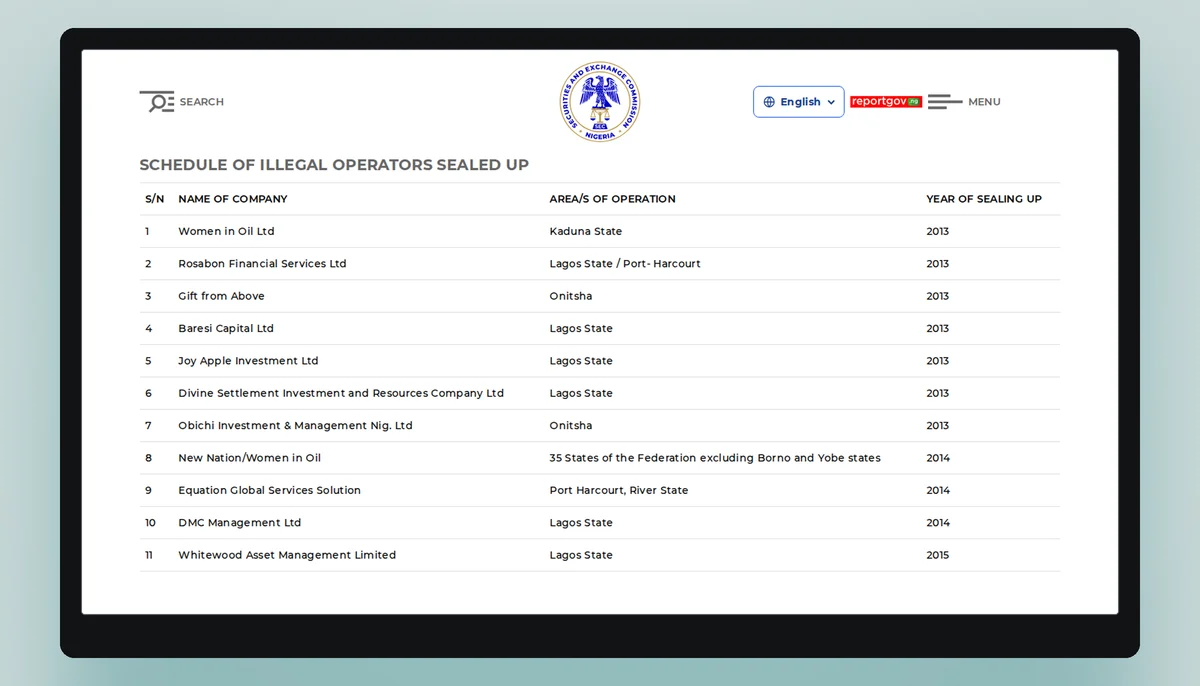
The Securities and Exchange Commission of Nigeria publishes a list of entities it calls known investment schemes. The Commission says these entities are not registered to take investments. The list is a public warning, not a court finding. This page explains what the list is, what each column in the table above shows, and what a reader should do with it.
Schemes named in SEC notices
The entity's name as the SEC wrote it and the SEC's date where given.
| Company as the SEC names it | Year sealed up | Entry | Source |
|---|---|---|---|
| 2022 | |||
| Farmforte Agro Allied Solutions | 2022 | Sealed up by the SEC | SEC ↗ |
| Ovaioza Farm Produce Storage Business | 2022 | Sealed up by the SEC | SEC ↗ |
| Oxford International Group | 2022 | Sealed up by the SEC | SEC ↗ |
| Vekt Capital Investment Limited | 2022 | Sealed up by the SEC | SEC ↗ |
| 2020 | |||
| Darrol Investment Limited | 2020 | Sealed up by the SEC | SEC ↗ |
| 2019 | |||
| Box value Trading Company | 2019 | Sealed up by the SEC | SEC ↗ |
| Federate Investors Trading Company | 2019 | Sealed up by the SEC | SEC ↗ |
| Flip Cash Investment | 2019 | Sealed up by the SEC | SEC ↗ |
| Helping Hand and Investment | 2019 | Sealed up by the SEC | SEC ↗ |
| Jamalife Helpers Global Ltd | 2019 | Sealed up by the SEC | SEC ↗ |
| Kudy Financial Ltd | 2019 | Sealed up by the SEC | SEC ↗ |
| Loom Nigeria Money | 2019 | Sealed up by the SEC | SEC ↗ |
| MBA Forex and Investment Ltd | 2019 | Sealed up by the SEC | SEC ↗ |
| Now Now Alert | 2019 | Sealed up by the SEC | SEC ↗ |
| 2017 | |||
| Yuan Dong | 2017 | Sealed up by the SEC | SEC ↗ |
| 2016 | |||
| All Trust Hertiage International Limited | 2016 | Sealed up by the SEC | SEC ↗ |
| Converged Dynamic International Limited | 2016 | Sealed up by the SEC | SEC ↗ |
| Fantastic Esanbet Nigeria Limited | 2016 | Sealed up by the SEC | SEC ↗ |
| Flexus Global Solutions Investment Ltd. | 2016 | Sealed up by the SEC | SEC ↗ |
| MMM Federal Republic of Nigeria | 2016 | Sealed up by the SEC | SEC ↗ |
| Ruby Gold Ventures | 2016 | Sealed up by the SEC | SEC ↗ |
| Tine God Network Limited | 2016 | Sealed up by the SEC | SEC ↗ |
| YBF Consult Limited | 2016 | Sealed up by the SEC | SEC ↗ |
| 2015 | |||
| Lamb & Lamb Ltd. | 2015 | Sealed up by the SEC | SEC ↗ |
| Madumon Investment Ltd | 2015 | Sealed up by the SEC | SEC ↗ |
| Powertronic Ltd | 2015 | Sealed up by the SEC | SEC ↗ |
| Stock Empire Ventures Limited | 2015 | Sealed up by the SEC | SEC ↗ |
| Whitewood Asset Management Limited | 2015 | Sealed up by the SEC | SEC ↗ |
| 2014 | |||
| DMC Management Ltd | 2014 | Sealed up by the SEC | SEC ↗ |
| Equation Global Services Solution | 2014 | Sealed up by the SEC | SEC ↗ |
| New Nation/Women in Oil | 2014 | Sealed up by the SEC | SEC ↗ |
| 2013 | |||
| Baresi Capital Ltd | 2013 | Sealed up by the SEC | SEC ↗ |
| Divine Settlement Investment and Resources Company Ltd | 2013 | Sealed up by the SEC | SEC ↗ |
| Gift from Above | 2013 | Sealed up by the SEC | SEC ↗ |
| Joy Apple Investment Ltd | 2013 | Sealed up by the SEC | SEC ↗ |
| Obichi Investment & Management Nig. Ltd | 2013 | Sealed up by the SEC | SEC ↗ |
| Rosabon Financial Services Ltd | 2013 | Sealed up by the SEC | SEC ↗ |
| Women in Oil Ltd | 2013 | Sealed up by the SEC | SEC ↗ |
What the table above shows
The table above this text is a live view of the SEC's list. Each row is one notice the regulator published. The columns show the name exactly as the source wrote it, the date the source published it, the type of scheme if the SEC states it, and a link to the original notice. The table is the regulator's act, not this site's verdict.
A row records what the source published. It does not mean this site has investigated the entity, or that any court has found the entity at fault. The table is a copy of a public document. The reader should open the link and read the SEC's own words.
What 'known investment schemes' means as a document
The SEC uses the phrase 'known investment schemes' for entities it names. The document is the Commission saying these entities are not registered to take investments. It is a warning to the public. It does not say that the entity is a scam, a fraud, or a pyramid. It says only that the entity is not registered with the SEC.
The document is not a complete list of every unregistered scheme. The SEC may name some and not others. A name absent from the list is not evidence that the entity is registered or safe. The list is one regulator's answer to one question: is this entity registered with us?
How to read a date on the list
Where the SEC gives a date for a notice, that date is shown in the table. The date is the regulator's own: it may be the date of the notice, the date of publication, or the date of the last update. The site does not alter it. The reader should check the original notice to see what the date refers to.
Where the SEC does not give a date, the site shows the date it first saw the entry and says so. That date is not a claim about when the SEC acted. It is a record of when this site observed the entry. The SEC's page may change between our weekly reads.
What the list does not say
The list does not say whether an entity is registered at the Corporate Affairs Commission. It does not say whether the entity is licensed by the Central Bank of Nigeria. It does not say whether the entity is a lawful direct-selling business. Each of those questions belongs to a different body.
The list is about investment schemes. It is not about general business registration or consumer protection. A reader who wants to know whether a company is registered at the CAC should ask the CAC. A reader who wants to know whether a company is licensed by the SEC should ask the SEC.
What to do with a name on the list
If you see a name you recognise on the list, read the SEC's notice. The notice will say what the Commission believes and what it advises the public to do. The reader should not rely on this site's summary; the original is the authority.
If you have already placed money with an entity on the list, the SEC's notice may tell you who to contact. It may also be worth asking your bank about the transfer you made. No body can promise a refund.
What to do with a name not on the list
A name absent from the list is not shown to be registered, licensed or safe. The SEC may not have named it yet. The scheme may be unregistered and yet not named. A reader who is considering an investment should ask the SEC directly whether the entity is registered.
The SEC's website has a search function for registered capital-market operators. You can also write to the Commission. Do not rely on this site alone. This site reports the SEC's notices; it does not certify any entity.
A notice can arrive long after money has moved
The SEC publishes a notice when it has enough material to act. By that date, an entity may have already collected funds from many people. The gap between the first invitation to invest and the published notice is not fixed. It depends on when the SEC receives complaints, completes its review, and approves the language of the warning.
A reader who sees a fresh notice should not assume the scheme started that week. The table shows the date of the SEC's announcement, not the date the entity began operating. Some schemes run for months before a notice appears. Others are flagged quickly if they resemble an earlier case or if the SEC receives a cluster of complaints in a short period.
This timing matters when a person asks whether they can recover money. The earlier a name appears on the list, the sooner the public can stop paying in. But the list is not a recovery tool. It only tells you the SEC has published a notice. Any money already sent remains a matter between the payer, the entity, and the courts.
The list is not a substitute for a licence check
A name on the list means the SEC has said the entity is not registered to take investments. It does not mean the entity is banned from every other activity in Nigeria. Some entities on the list hold a valid CAC certificate for a different line of business, such as trading or consulting. That certificate does not authorise them to collect money for a return.
Before committing money, a reader should check the SEC's register of capital market operators. That register is separate from the list of known investment schemes. The list is a warning, while the register is a positive confirmation. An entity that appears on neither still requires a licence if it is inviting the public to invest.
The order of operations is simple: first check the SEC register for a licence, then check the list for a warning. If the entity is on the list, stop. If it is not on the list but also not on the register, do not proceed. Only a licence from the SEC, or another regulator with authority over that type of investment, makes an invitation lawful.
A CAC certificate does not bless an investment scheme
The Corporate Affairs Commission registers companies for legal existence. It does not assess whether a business model is lawful or whether it can collect money from the public. Many entities on the SEC's list have a CAC certificate. The certificate only means the company exists as a legal person and can open a bank account, sue, and be sued.
The SEC's warning does not cancel a CAC certificate. The two registries serve different purposes. A reader who sees a CAC certificate and assumes the investment is safe has confused company registration with market regulation. The SEC is the body that checks whether an entity can offer investments, not the CAC.
This confusion is common because promoters show a CAC certificate as proof of legitimacy. The certificate is real, but it is not a licence to take deposits or promise returns. When an entity on the list shows a CAC certificate, the correct response is to note that the certificate does not remove the SEC's warning.
The list grows when complaints become public
The SEC does not have a fixed schedule for adding names. A new notice often follows a pattern of complaints from investors who cannot withdraw their money or who see their promised returns stop. The SEC may also act on its own surveillance or on a referral from another regulator, such as the Central Bank or the EFCC.
Once the SEC is satisfied that an entity is operating without registration, it drafts a notice and publishes it on its website and in selected media. The date on the table is the date of publication. The list is cumulative, so older notices remain visible even after the entity changes its name or shuts down.
A reader who has been invited to invest in something not on the list should not assume it is safe. The absence of a notice may simply mean the SEC has not yet published one. The list is a record of what the SEC has said so far, not a complete map of every unlawful scheme in Nigeria.
A name change does not erase a notice
Some entities on the list later rebrand or register a new company name. The SEC's notice refers to the name it used at the time of publication. If the same people behind a scheme start a new platform under a different name, the old notice remains on the list, but the new name may not appear until the SEC publishes a fresh notice.
A reader who encounters a new name that resembles an old one on the list should check the SEC's website for any updated notice. The SEC sometimes publishes a follow-up notice linking the new name to the old one. When it does, the table will show the new name with its own date, but the original notice stays.
The practical lesson is that a name not on the list is not proof of a clean record. It may be a new name for an old scheme. The only way to be sure is to check the SEC register for a licence and to ask the promoter for the certificate of registration as a capital market operator.
The SEC's notice is a statement, not a verdict
When the SEC publishes a name on its list, it is saying that the entity is not registered with the SEC to carry out investment business. It is not a court judgment. The SEC does not have the power to declare an entity a scam or to order it to pay back money. That power belongs to the courts, the EFCC, or other law enforcement agencies.
A reader who sees a name on the list should treat it as a warning to stop any further payment. The SEC's notice is the regulator's official position, and it carries weight. But the notice alone does not resolve any dispute about money already paid. A person who has lost money must pursue a separate civil or criminal case.
The list's value is in its timeliness and its authority. It tells the public what the SEC has found and when it found it. It does not promise that the entity will be shut down or that investors will recover their money. The reader decides what to do with the information.
Key facts about the list
Read next
Asked at the point of paying in
Is the SEC's list a list of scams?
The SEC's list is a list of entities the Commission says are not registered to take investments. It is a warning, not a finding that an entity is a scam. The SEC may have other reasons for naming an entity. The reader should read each notice.
Does the list include every unregistered scheme?
No. The SEC may name some and not others. A name absent from the list is not evidence that the entity is registered or safe. The list is one regulator's answer to one question.
What does the date on a notice mean?
The date is the regulator's own: it may be the date of the notice, the date of publication, or the date of the last update. Where the SEC does not give a date, this site shows the date it first saw the entry and says so.
Can I check if a company is registered at the CAC?
Yes. The Corporate Affairs Commission has its own register. Registration at the CAC is a different fact from registration with the SEC. Ask the CAC about CAC registration; ask the SEC about SEC licensing.
What should I do if I have money with an entity on the list?
Read the SEC's notice. It may say who to contact. You can also ask your bank about the transfer. No body can promise a refund.
Open a CFD account with an international broker
If you are looking for a broker to trade contracts for difference, this site links to FxPro. Read the risk warnings and the client agreement before opening an account.