
Direct selling versus a pyramid
A lawful direct-selling business pays its distributors for selling real products to customers. A pyramid pays its members for enrolling new members. The product, if any, is a cover. The question is where the income comes from. This page explains the difference and the role of the consumer protection authority.
The essential difference
In a lawful direct-selling business, the income of a distributor comes mainly from product sales to customers who are not distributors. The product is real, has a market, and is sold at a price that reflects its value. The business can continue without enrolling new distributors.
In a pyramid, the income of a member comes mainly from enrolling new members. The product, if any, is overpriced or has little market outside the scheme. The business depends on recruitment. The product is a cover for the recruitment engine.
How to tell them apart
Ask the promoter: What percentage of your income comes from product sales to customers, and what percentage comes from enrolling new members? If the answer is mostly from enrolling, it is a pyramid. Also ask: Can a distributor earn without enrolling anyone? In a lawful business, the answer is yes.
Look at the product. Is it something people would buy at that price if there were no income opportunity? If not, the product is a cover. The real product is the recruitment.
The role of the FCCPC
The Federal Competition and Consumer Protection Commission has a role in consumer protection and fair competition. It can act against misleading trade practices. A pyramid scheme that misleads consumers may fall under its remit, but the FCCPC does not license investment schemes.
The SEC's role is different. The SEC warns about investment schemes. A direct-selling business that is not offering investments may not need SEC registration. But if the business is taking deposits or promising returns, the SEC may consider it an investment scheme.
A registered business can still run a pyramid
A company can be registered at the Corporate Affairs Commission and still run a structure the SEC warns about. CAC registration makes a legal person exist; it does not mean the business is lawful or that its structure is not a pyramid.
The SEC may name an entity on its list of known investment schemes even if that entity is registered at the CAC. The two registers answer different questions. A reader should check both, and should understand that CAC registration is not a licence to take investments.
What a lawful direct-selling business looks like
A lawful direct-selling business has a real product, a clear refund policy, and income that comes mainly from sales. It does not require a large upfront payment to join, and it does not pay for recruiting. The business can survive without new distributors.
The business is usually a member of a direct-selling association, but that is not a guarantee. The reader should still read the terms and ask the questions above. No body certifies a business as safe.
What the SEC says about pyramids
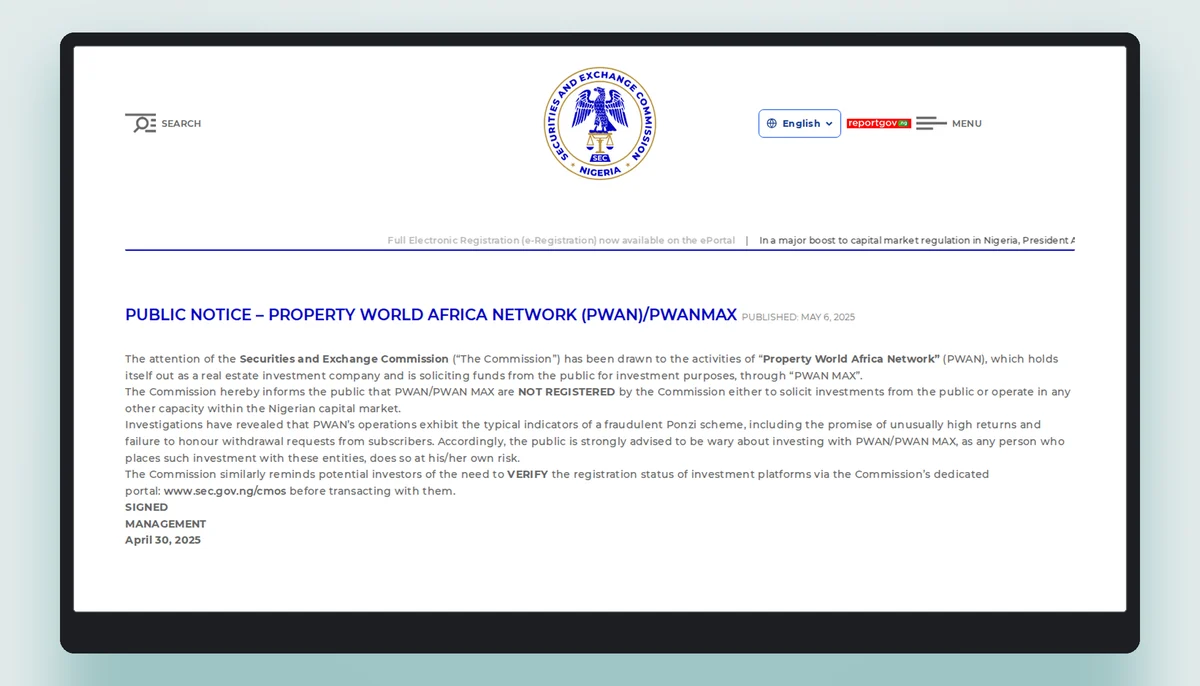
The Securities and Exchange Commission of Nigeria warns against pyramid schemes. The Commission says that entities offering investments must be registered with it. A pyramid scheme that takes money from the public is an investment scheme, even if it calls itself a direct-selling business.
The SEC's list of known investment schemes may include entities that operate as pyramids. The reader should check the list. The SEC's notices are warnings, not court findings.
The joining fee is not the only test
A lawful direct-selling business may ask a new distributor to buy a starter kit. The kit contains products for personal use or demonstration. The cost of the kit should reflect the value of those products at a normal retail price. If the kit is a token item and the real cost is the right to recruit others, the structure is leaning the other way.
In a pyramid, the joining fee buys nothing of substance. The money goes up the line to earlier joiners. The new member must then bring in more people to recover that fee. The product is an afterthought. The fee is the product.
Ask what a new member receives in exchange for the joining payment. If the answer is access to a compensation plan, not goods, the fee is a recruitment charge. A regulator may still take an interest even when the company calls it a membership fee.
Inventory loading is a warning sign
Some direct-selling businesses push distributors to buy large amounts of stock in advance. The distributor is told the stock will sell quickly. When it does not, the distributor is left with unsold goods and no refund. This practice is called inventory loading.
A lawful business earns from sales to end consumers. A pyramid earns from sales to its own distributors. If the compensation plan rewards the purchase of stock more than the sale of stock, the incentive is to recruit buyers, not customers.
Ask the promoter whether the plan pays for recruiting a new distributor or for the first order that distributor places. If the answer is the same thing, the stock is a vehicle for moving money between members.
Product returns reveal the structure
A lawful direct-selling business usually has a returns policy. A distributor can send back unsold products and get a refund, minus a small restocking fee. This protects the distributor from being stuck with goods nobody wants.
A pyramid has no reason to accept returns. The products were never meant to be sold to the public. They were a cover for the joining fee. If the company refuses returns or makes the process difficult, the product is not the point of the business.
Ask whether the company will buy back inventory from a distributor who leaves. If the answer is no, the distributor carries all the risk. The company makes money when the distributor buys, not when the distributor sells.
The compensation plan tells the truth
A compensation plan is the document that says who gets paid for what. In a lawful direct-selling business, the plan pays a commission on sales made to customers outside the network. The commission may be a percentage of the sale price.
In a pyramid, the plan pays for enrolling new members. The payment may be called a bonus, a referral fee, or a team commission. The amount depends on how many people join under you, not on how much product reaches the public.
Ask to see the compensation plan before you join. Look at the largest source of income for a typical distributor. If most of the money comes from downline activity, the plan rewards recruitment, not retail.
A genuine customer base is the dividing line
A lawful direct-selling business sells to people who are not distributors. Those customers buy the product because they want it, not because they want to join. The business can show that a meaningful share of its revenue comes from outside its own network.
A pyramid sells mostly to its own members. The same people who join are the ones who buy the product. The product may be consumed, but the consumption is a side effect of the membership, not the reason for it.
Ask the promoter what percentage of sales go to people who never join. If the promoter cannot answer or the answer is very small, the business depends on its own members for revenue. That is the pyramid's signature.
Exit and refund terms separate the two
A lawful direct-selling business allows a distributor to leave. The distributor can stop selling, return unsold products, and walk away without a penalty. The contract has a clear exit clause and a refund policy.
A pyramid makes leaving costly. The distributor has already paid a joining fee and bought inventory. There is no refund for the fee. The products cannot be returned. The only way to recover the money is to recruit others, which keeps the member trapped.
Ask what happens to your money if you change your mind after a month. If the answer is that you lose it, the business has no interest in protecting you as a participant. It only needs you as a source of funds.
The payout structure reveals the source of the money
A lawful direct-selling business pays commission on the sale of a product to a final customer. The commission is a share of the margin on that product, and it is paid after the sale is completed. If the customer returns the product, the commission is clawed back. The money flows from the customer to the company, and the company pays a portion to the seller.
A pyramid pays recruitment bonuses and leadership overrides that are not tied to any product sale to an outside customer. The reward comes from the joining fees and the purchases made by new members as a condition of entry. When recruitment slows, those bonuses shrink even if members are still buying the products for themselves.
Ask the promoter to show the compensation plan. If the largest rewards in the plan are for enrolling new members rather than for selling goods to people who are not members, the structure is a pyramid. A plan that rewards only product sales can still be a bad business, but it is not a pyramid.
A genuine product can hide a recruitment-driven structure
Some pyramids attach a physical product to the scheme, such as a soap, a supplement or a phone data bundle. The product exists, and sometimes it is of reasonable quality. But the product is priced far above comparable goods in the open market, and the difference is the recruitment fee in disguise. Members are told the product is an investment or a business kit.
The test is whether a person who is not a member would buy the product at that price. If the only buyers are members who joined to qualify for bonuses, the product is not the source of income. The scheme earns from the difference between the cost of the product and the inflated price paid by new members.
Ask what happens if a member sells the product to a final customer and recruits no one. In a lawful direct-selling business, that member still earns commission. In a pyramid, the member earns little or nothing because the real reward is for bringing in new members who will also pay the inflated price.
The exit path tells you whether you are a customer or a recruit
In a lawful direct-selling business, a member can stop selling and simply walk away. The company may buy back unsold inventory at a stated price, and there is no penalty for leaving. The relationship is between the seller and the company, and it ends when the seller stops selling.
In a pyramid, leaving is difficult because the member has paid a joining fee and bought inventory that cannot be returned. The only way to recover that cost is to recruit others, so the member becomes a recruiter even if they did not intend to. The scheme depends on this lock-in: every member is under pressure to bring in new members to recover their own money.
Before you pay any money, ask what happens if you change your mind the next day. If the answer is that you can get a refund, the structure is more likely to be lawful direct selling. If the answer is that you should find other people to join, the structure is a pyramid.
Key differences
Read next
Asked at the point of paying in
What is the main difference between MLM and pyramid?
In MLM, income comes mainly from product sales to customers. In a pyramid, income comes mainly from enrolling new members. The product in a pyramid is a cover.
Can a lawful MLM require a joining fee?
A lawful MLM may charge a small fee for materials, but it should not require a large upfront payment. The fee should not be the main source of income for the company.
What should I ask the promoter?
Ask where the income comes from, whether a distributor can earn without enrolling, and whether the product has a market outside the scheme. Vague answers are a warning.
Does the FCCPC regulate MLMs?
The FCCPC has a role in consumer protection and fair competition. It can act against misleading practices. But it does not license investment schemes. The SEC regulates investment schemes.
Can a company be registered at CAC and still be a pyramid?
Yes. CAC registration makes a legal person exist. It does not mean the business is lawful or that its structure is not a pyramid. The SEC may warn about a CAC-registered company.
Open a CFD account with an international broker
If you are looking for a broker to trade contracts for difference, this site links to FxPro. Read the risk warnings and the client agreement before opening an account.