
CAC registration is not an SEC licence
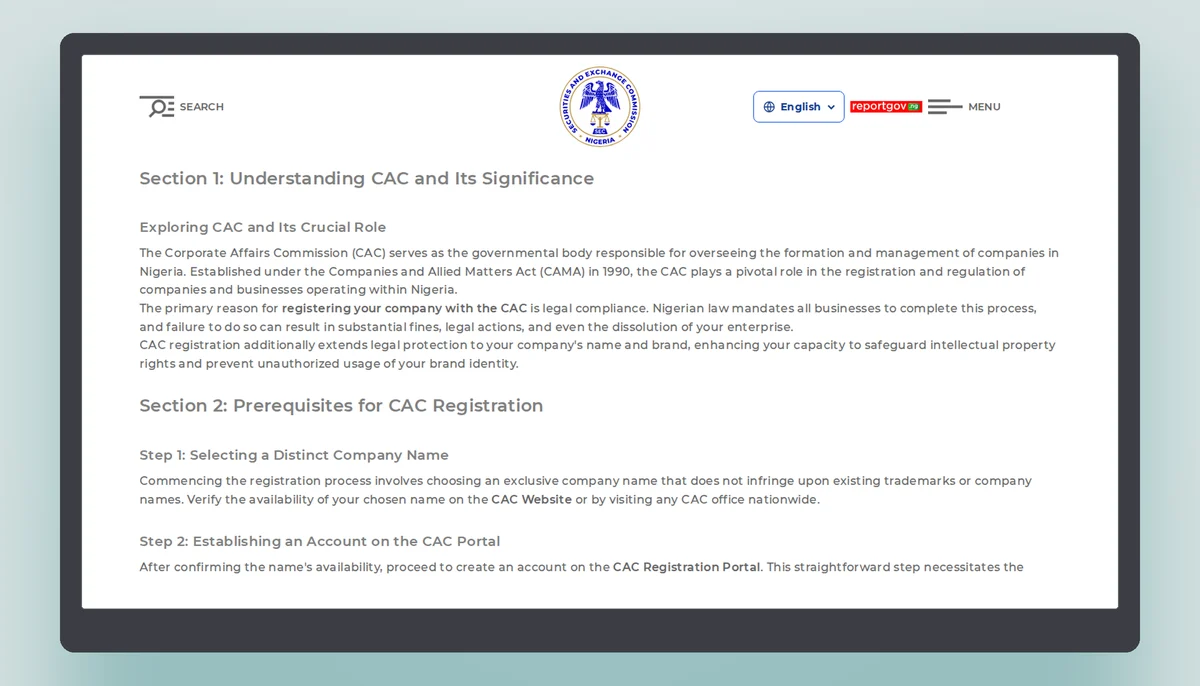
Registration at the Corporate Affairs Commission makes a legal person exist. Registration or licensing by the Securities and Exchange Commission permits a person to deal in securities. The two are different facts, recorded in different registers. This page explains the difference and how to ask each body.
What CAC registration means
The Corporate Affairs Commission registers companies and other legal entities in Nigeria. Registration gives the entity a legal personality: it can own property, sue and be sued, and enter into contracts. It does not mean the entity is authorised to take investments or deal in securities.
A company registered at the CAC may be a trading company, a manufacturer, a service provider, or anything else. The CAC does not regulate investment business. It only registers the existence of the entity.
What SEC registration means
The Securities and Exchange Commission registers and licenses capital-market operators. These are entities that deal in securities, manage investments, or provide investment advice. SEC registration is a permission to carry on those activities.
The SEC's register is separate from the CAC's register. An entity may be registered at the CAC but not licensed by the SEC. An entity may be licensed by the SEC and also registered at the CAC. The two questions are different.
How to ask the CAC
The Corporate Affairs Commission has a public search on its website. You can search by company name to see if an entity is registered. The search shows the registration number and the date of registration. It does not show whether the entity is licensed by the SEC.
You can also visit a CAC office or use an accredited agent. Ask for a status report if you need details. The CAC does not give investment advice. It only tells you whether a company exists.
How to ask the SEC
The Securities and Exchange Commission has a public search for registered capital-market operators on its website. You can search by name to see if an entity is licensed. The search shows the type of licence and the date of registration.
If you cannot find an entity on the SEC's register, it is not licensed by the SEC. You can also write to the SEC to confirm. The SEC's list of known investment schemes names entities it says are not registered. Check that list too.
Why the difference matters
A scheme may tell you it is registered at the CAC and use that as proof that it is legitimate. But CAC registration is not a licence to take investments. The SEC is the body that licenses capital-market operators. If an entity is taking investments and is not on the SEC's register, it is not authorised to do so.
The SEC's list of known investment schemes includes entities that are registered at the CAC but not with the SEC. The Commission says these entities are not registered to take investments. A reader should check both registers.
A company can be registered at CAC and still be warned by SEC
The SEC may name an entity on its list of known investment schemes even if that entity is registered at the CAC. CAC registration does not protect an entity from SEC warnings. The SEC's warning is about investment activities, not about the existence of the company.
If you see an entity on the SEC's list, read the notice. The notice will say what the Commission believes and what it advises. The reader should not rely on CAC registration alone.
The CAC register answers a different question from the SEC register
When a company is registered at the Corporate Affairs Commission, the register answers one question: does this legal person exist? The CAC records the name, the shareholders, the directors and the stated objects of the company. It does not record whether the company may collect deposits, manage investments or sell securities. Those activities need a separate licence from a sector regulator.
The Securities and Exchange Commission keeps its own register of capital market operators. An entry there answers a different question: is this entity permitted to carry on a regulated investment activity? The SEC register shows the category of licence, the conditions attached to it and the current status. A name can appear on the CAC register without appearing on the SEC register.
The two registers are not interchangeable. Checking one register does not discharge the duty of checking the other. A person who confirms a company exists at the CAC has not confirmed that the company may take investment funds. The reverse is also true: an SEC licence does not replace CAC incorporation, because the company must exist before it can be licensed.
The SEC licence is activity-specific, not a general approval
A licence from the Securities and Exchange Commission is not a single badge that covers everything. The SEC issues different categories of registration for different capital market functions. A firm may be registered as a broker, a fund manager, an issuing house, a registrar or a trustee. Each category carries its own rules, capital requirements and permitted activities.
A company registered to act as a broker cannot automatically act as a fund manager. A company registered to manage a collective investment scheme cannot automatically hold itself out as a custodian. The licence states the activity the company may perform, and the company must stay within that activity. Doing otherwise is a breach of the licence conditions.
When a platform claims to be 'SEC registered', the first question is: registered for what activity? The register will show the category. A platform that is registered as a broker has no authority to pool funds for investment. A platform that is registered as a fund manager has no authority to execute trades on the exchange. The activity matters more than the licence itself.
A platform can hold a CAC certificate and still be outside the SEC's reach
Many online platforms that ask for money from the public are incorporated at the Corporate Affairs Commission. They use the CAC certificate as evidence that they are legitimate businesses. But the SEC's reach is determined by the activity, not by the incorporation status. If the activity is a capital market activity, the SEC's rules apply whether or not the company is incorporated.
The SEC has published notices about entities that are registered at the CAC but are not registered with the SEC for the investment activity they carry on. The SEC's concern is not whether the company exists, but whether it is doing a regulated activity without a licence. A CAC certificate does not exempt a company from the SEC's oversight.
A company that collects money from the public and promises a return is likely carrying on a capital market activity. If it is not registered with the SEC for that activity, it is outside the SEC's authorisation. The CAC register will not show this. The SEC register will not show it either, because the company is not on the SEC register. The absence from the SEC register is itself the warning sign.
The cost of checking the wrong register is borne by the investor
When a person checks only the CAC register and sees a company name, they may feel assured. The company exists. The directors are listed. The objects clause says the company can do business. But the objects clause does not create a licence. The cost of this mistaken assurance is borne entirely by the person who puts money into the scheme.
The SEC register is the place to check for capital market operators. If the entity is not there, the investor has no regulatory protection from the SEC. The SEC cannot compensate an investor who gave money to an unregistered entity. The SEC can only warn the public and, where the law allows, take enforcement action against the promoters.
The order of checks matters. First, confirm the company exists at the CAC. Second, confirm the company is licensed by the SEC for the specific activity it is offering. Third, read the SEC's published notices to see if the company has been named. Skipping the second step is the most common way people lose money.
The SEC's notices do not depend on the CAC's records
When the Securities and Exchange Commission publishes a notice about an entity, it does so because the entity is carrying on a capital market activity without the SEC's authorisation. The notice does not say whether the entity is registered at the CAC. The notice is about the activity, not the incorporation status.
An entity can be fully incorporated at the CAC, with all its annual returns filed, and still be the subject of an SEC notice. The SEC is not saying the company does not exist. The SEC is saying the company is doing something that requires an SEC licence and does not have one. The two facts can be true at the same time.
A reader who sees an SEC notice should not rush to the CAC register to see if the company exists. The company probably does exist. The question is whether it has the SEC licence for the activity it is doing. The SEC notice is the answer to that question. The CAC register is irrelevant to the SEC's warning.
The promoter's explanation will rarely mention the missing licence
When a platform is challenged about its registration status, the promoter will often point to the CAC certificate. The promoter will say the company is registered, the directors are known and the office is open. The promoter will not volunteer that the company has no SEC licence for the investment activity. The missing licence is the gap the promoter hopes the customer will not notice.
The promoter may also say that the SEC's licence is not needed because the business is not an investment business. The promoter may call it a cooperative, a thrift, a contribution scheme or a network marketing business. The labels are chosen to move the activity out of the SEC's jurisdiction. But the SEC looks at what the entity actually does, not what it calls itself.
A customer who asks the promoter for the SEC licence number will often receive a CAC registration number instead. The customer should then ask: for what activity is the company registered with the SEC? If the answer is that the company is not registered with the SEC, the customer has the information needed to make a decision.
The CAC registers a legal person; the SEC licenses a market activity
A certificate of incorporation from the Corporate Affairs Commission creates a company as a legal person that can open a bank account, own property and sue in its own name. It does not, by itself, permit that company to take money from the public for investment. The SEC licence attaches to a specific market function, such as fund management or issuing securities, and is granted only after the applicant meets additional capital and governance requirements.
Many readers assume that a CAC certificate shown by a promoter is a sign that the investment side of the business has been checked. That is not what the CAC does. The Commission examines whether the company's objects are lawful and whether its registration forms are complete; it does not assess whether the investment model can sustain the returns being promised. An entity can be fully compliant at the CAC and still be operating an unlicensed investment scheme.
The practical consequence is that a CAC registration number is irrelevant to the question of whether the entity may lawfully hold or manage other people's money. When a promoter points to a CAC certificate as proof of regulatory approval, the correct next step is to ask for the SEC registration number for the specific activity being offered. If none is produced, the CAC document is simply evidence that a company exists, not that its investment operation is licensed.
Two registers
Read next
Asked at the point of paying in
What is the difference between CAC and SEC?
The CAC registers companies; the SEC licenses capital-market operators. CAC registration makes a legal person exist; SEC registration permits dealing in securities.
Can a company be registered at CAC but not at SEC?
Yes. Many companies are registered at the CAC but are not capital-market operators. They do not need SEC registration unless they offer investments to the public.
How do I check if a company is registered at CAC?
Use the CAC's public search on its website. You can search by company name. The search shows the registration number and date.
How do I check if a company is licensed by SEC?
Use the SEC's public search for registered capital-market operators on its website. You can search by name. If the entity is not there, it is not licensed.
Does CAC registration mean the company is safe?
No. CAC registration only means the company exists. It does not mean the company is authorised to take investments or that its business is lawful.
Open a CFD account with an international broker
If you are looking for a broker to trade contracts for difference, this site links to FxPro. Read the risk warnings and the client agreement before opening an account.